
Nuts
Cashew Kernels
W180–W450 Grades · Vacuum / Gas-Flushed · FOB Dar es Salaam · 24-Hour RFQ Response
Shelled Tanzanian cashew kernels, W180 to W450 grades, vacuum-sealed or gas-flushed for export freshness. A value-added product supplied direct to food manufacturers and confectioners.
Incoterm
FOB Dar es Salaam
Pricing confirmed by Proforma Invoice within 24 hours of your RFQ
Request a Quote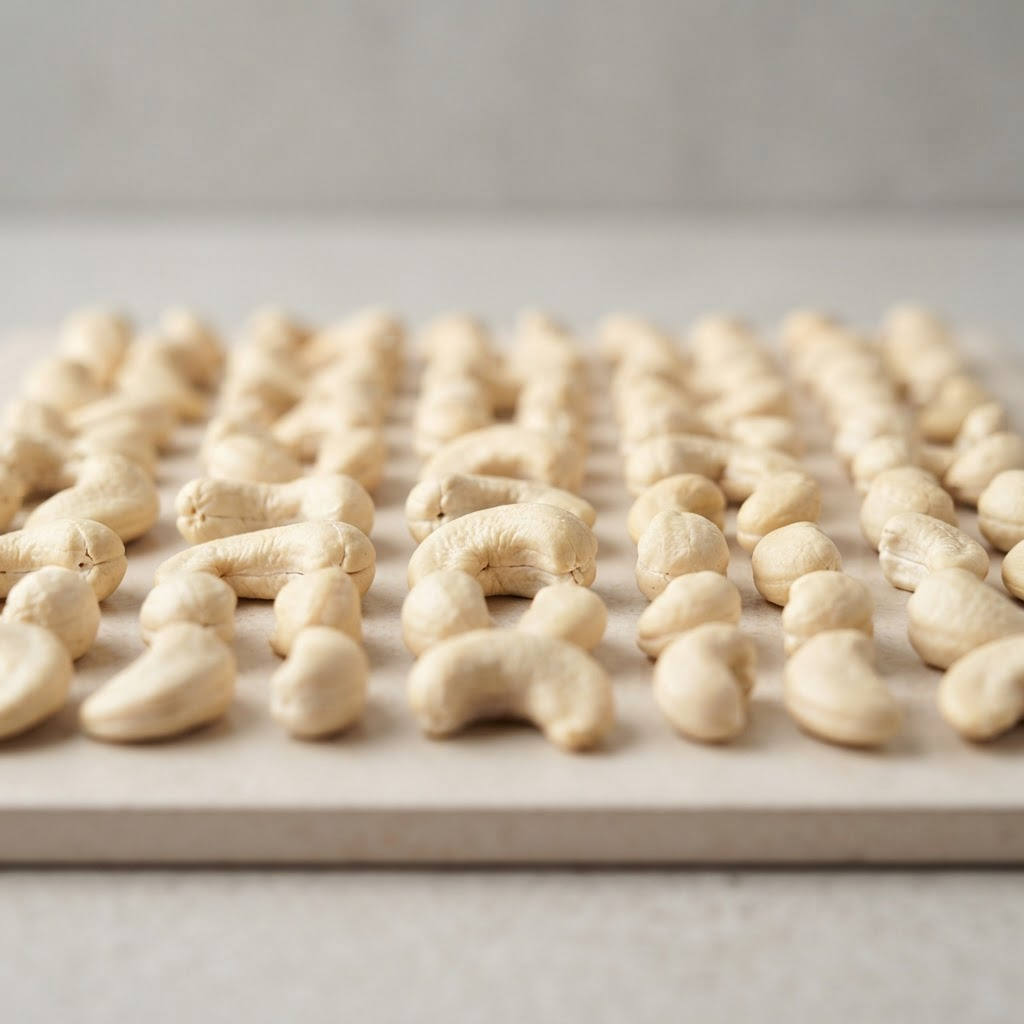
Product Overview
Beyond raw in-shell nuts, Nexus also supplies shelled cashew kernels — a separate, value-added export product graded on the international W-grade system (W180 through W500, plus scorched and broken grades). W320 is the benchmark, most widely traded grade globally; larger grades like W180 and W240 command premium positioning.
Shelled kernels are highly susceptible to oxidative rancidity once processed, so packaging is a quality-critical step: kernels are vacuum-sealed or nitrogen/CO2 gas-flushed before hermetic sealing, in either tins or multi-layer flexible pouches, to remove oxygen entirely and preserve shelf life through the export supply chain.
Kernel buyers are typically food manufacturers, confectioners, and ingredient companies sourcing directly rather than through a further processing step — a shorter, more traceable supply chain than routing through offshore processing hubs. Nexus exports FOB Dar es Salaam; standard export units are 25lb or 50lb net weight per tin or pouch for EU/US-bound shipments, and 10kg tins for Middle East-bound shipments.
Technical Specifications
| Product | Shelled white cashew kernels |
|---|---|
| Grades | W180, W240, W320 (benchmark), W450 |
| Also Available | Scorched & broken grades |
| Moisture | Max 5% |
| Packaging | Vacuum-sealed or nitrogen/CO2 gas-flushed |
| Export Units | 25lb / 50lb tins or pouches (EU/US); 10kg tins (Middle East) |
Shelled Kernel Grades
| Grade | Kernels per lb | Description |
|---|---|---|
| W180 | 140-180 | Largest, premium |
| W210 | ~180-210 | Premium large |
| W240 | 220-240 | Premium large |
| W320 | 300-320 | Most widely traded grade |
| W450 | ~450 | Small |
| SW series | Same size bands | Scorched (discoloured) |
Origin
Where Our Cashew Kernels Is Grown
Explore the verified Tanzanian growing regions on the map, then review what makes each origin distinct.
Click a marker to see the region profile.
Mtwara (dominant)
Source of the raw nuts behind the kernels — the heart of the southern cashew belt.
Lindi
Neighbouring southern region and the second major raw cashew growing area.
Sensory & Quality Characteristics
Shelled Tanzanian cashew kernels are graded on colour, wholeness, and size band. The benchmark W320 grade offers a creamy-white colour and buttery flavour sought by food manufacturers and confectioners.
Because kernels are highly susceptible to oxidative rancidity, packaging is quality-critical: kernels are vacuum-sealed or nitrogen/CO2 gas-flushed to preserve freshness through the export supply chain.
From Farm to Export
Kernels are produced from raw nuts by steam conditioning, shelling, drying, peeling, and grade-sorting into the W-grade bands.
Finished kernels are vacuum-sealed or gas-flushed and hermetically packed — typically 25lb or 50lb tins/pouches for EU/US-bound shipments, and 10kg tins for Middle East-bound shipments.
Value
Why Source Cashew Kernels from Tanzania?
Value-Added Product
A finished, food-grade product supplied direct to manufacturers rather than through further offshore processing.
Full Grade Range
W180 through W450 plus scorched grades, matching a range of end-use requirements.
Export-Ready Packaging
Vacuum-sealed or nitrogen-flushed packing preserves freshness and shelf life in transit.
Traceable Origin
Kernels trace back to southern Tanzania raw nuts, an increasing share of which move through the TMX auction.
Quality Assurance
Certifications, Standards & Testing
How quality is graded, controlled, and independently verified before every shipment.
Certifications & Standards
Regulatory body: Cashewnut Board of Tanzania (CBT)
Kernels are graded on the international W-grade system and to national standards, under the oversight of the Cashewnut Board of Tanzania.
Organic and food-safety scheme certifications can be discussed at RFQ stage.
Traceability
Each shipment is accompanied by documentation that traces the product back to its origin.
Provided: Certificate of Origin, phytosanitary certificate, and quality certificates.
Benefit: A transparent supply chain and verifiable trust with buyers.
Detailed Quality Standards
| Grade | Specification | Standard |
|---|---|---|
| W320 | 300-320 kernels/lb | TZS 739:2018(E) |
| W240 | 220-240 kernels/lb | TZS 739:2018(E) |
| W180 | 140-180 kernels/lb | TZS 739:2018(E) |
Testing & Inspection Process
- Pre-shipment inspection: by SGS, Bureau Veritas, or Cotecna.
- What is tested: Quality, quantity, weight, moisture, defects, and packaging.
- When: Before loading at the port of shipment.
- Who pays: Typically the seller or buyer (negotiable).
| Company | Service | Cost |
|---|---|---|
| SGS | Inspection, testing, certification | Quoted per shipment |
| Bureau Veritas | Inspection, testing, certification | Quoted per shipment |
| Cotecna | Inspection, testing, certification | Quoted per shipment |
Aflatoxin Testing
- Why it matters: Aflatoxins are toxic compounds produced by certain fungi and are strictly regulated in international food trade.
- Testing method: ELISA or HPLC.
- Limit: Max 10 ppb total aflatoxins (TBS standard).
- Frequency: Tested on every shipment for susceptible commodities such as cashew, maize, and spices.
Logistics
Export Logistics & Shipping
Everything you need to plan the supply chain — from Incoterms to documentation and storage.
Shipping Methods Explained
| Method | Description | Cost | Buyer Responsibility |
|---|---|---|---|
| FOB | Free On Board — seller delivers the goods, cleared for export, onto the vessel at the port of shipment. | Lower | Buyer arranges and pays for ocean freight, insurance, and import duties. |
| CIF | Cost, Insurance, Freight — seller covers cost, insurance, and freight to the destination port. | Higher | Seller arranges freight and insurance. Buyer handles import duties and clearance. |
| CFR | Cost and Freight — seller covers cost and freight to the destination port. | Medium | Buyer arranges insurance. Seller handles freight. |
Estimated Shipping Timeline
- 01
Contract Signing
Day 0
- 02
Sourcing & Verification
Days 1–3
- 03
Loading & Documentation
Days 4–7
- 04
Departure (FOB)
Days 8–14
- 05
Transit
Days 15–35 (destination-dependent)
- 06
Arrival & Customs
Days 36–40
Container Types
20ft Container
~18,000 kg · Smaller shipments, trial orders
40ft Container
~26,000 kg · Larger volumes, cost-effective per kg
LCL (Less than Container Load)
Partial container · Smaller quantities (< 18,000 kg)
Port of Dar es Salaam
- Capacity: Annual throughput capacity of ~20 million tonnes
- Avg. dwell time: 7 days (2024 data)
- Features: Dedicated container terminal, bulk cargo handling, rail and road connections
Source: Tanzania Ports Authority (TPA)
Insurance
- Marine insurance can be arranged by the buyer or seller, depending on the agreed Incoterm.
- Covers: Loss or damage to cargo during transit, including theft, weather damage, and handling.
- Providers: Local and international providers (e.g. Jubilee Insurance, ZEP-RE).
- Typical cost: 0.5–2% of the shipment value.
Customs Documentation Checklist
- Proforma Invoice
- Commercial Invoice
- Packing List
- Bill of Lading
- Certificate of Origin (Tanzanian)
- Phytosanitary Certificate
- Fumigation Certificate (if applicable)
- Quality / Weight Certificate
Handling & Storage
Temperature
15–20°C
Humidity
65–70%
Must be kept dry. Kernels must remain vacuum-sealed or nitrogen-flushed until use to prevent rancidity.
Market Intelligence
Market Context & Availability
Verified market context to help you plan — availability, export markets, and how the origin compares.
Harvest & Export Availability
Peak availability by month (gold). The current month is outlined.
National Export Volume
528,263 tonnes raw crop (2024/25)
Key Export Markets
Vietnam, India, USA, EU
Competitor Origin Comparison
| Origin | Strengths | Weaknesses |
|---|---|---|
| Tanzania(This origin) | Specialty reputation, distinct flavour profiles, high quality, traceability | Lower production volume, longer shipping routes |
| Brazil | High volume, consistent quality, large supply | Less differentiation, limited specialty reputation |
| Vietnam | Low cost, large scale (coffee, cashew) | Quality inconsistency, less traceability |
| India | Large market, strong demand for cashew and spices | Limited specialty exports, higher logistics costs |
Port Congestion
Dar es Salaam average dwell time is 7 days.
Lead Time
Typical FOB shipments take 14 days from contract signing to loading.
Global Demand
Demand for African commodities is rising, especially in specialty markets.
FAQ
Cashew Kernels — Frequently Asked Questions
What grades are available?
Kernels are offered across the W-grade system — W180, W210, W240, W320 (most traded), and W450 — plus scorched (SW) grades. Packing is vacuum-sealed or nitrogen/CO2 gas-flushed.
Can I request a sample?
Yes. Representative samples can be provided on request; sample costs and shipping are agreed on a case-by-case basis.
What is the lead time?
Typical lead time is 21 days from confirmed RFQ, subject to harvest availability and order volume.
What documentation is provided?
Every shipment includes a full export documentation package: Commercial Invoice, Packing List, Bill of Lading, Certificate of Origin, Phytosanitary Certificate, Fumigation Certificate (where applicable), and Quality / Weight Certificate.
Is the product certified?
All consignments are graded to Tanzania Bureau of Standards (TBS) specifications, with independent third-party pre-shipment inspection (e.g. SGS, Bureau Veritas, or Cotecna) available at buyer request. Additional scheme certifications can be discussed at RFQ stage.
Ready to Source Cashew Kernels?
Submit your requirements and receive a Proforma Invoice within 24 hours.